
When you’re comparing Antarctic trips, “Zodiac cruising” can sound like one of those expedition terms you’re somehow supposed to already understand.
Is it just the little boat that takes you from the ship to shore? Is it an actual activity? How long are you out there? And what are you doing the whole time?
If you’ve never been in one, those are completely fair questions.
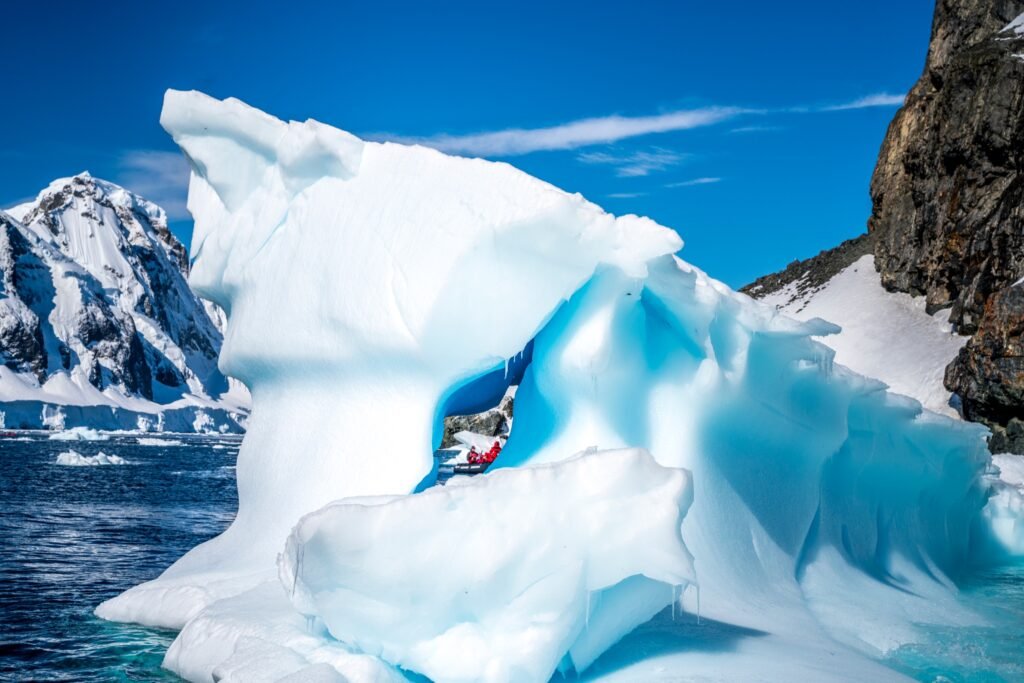
A Zodiac can take you to a landing, but a dedicated Zodiac cruise is an experience all on its own. You’re exploring from the water, close enough to really notice the shape of the ice, watch for wildlife, and ask your guide all the questions that start popping into your head.
It’s easy to plan an Antarctic trip around getting onto land. Stepping onto the continent for the first time is definitely a big moment! But Neill’s description of Zodiac cruising might surprise you: “The magic of Antarctica happens in the Zodiacs.” Here’s what that actually means when you’re the one getting into the boat.
First, what is a Zodiac cruise?
A Zodiac is a small, motorized inflatable boat used during expedition trips. It may shuttle you between the ship and a landing site, or your whole outing may take place in the boat. If you’re still trying to picture the difference, this guide to landings versus Zodiac cruises is a helpful place to start.
On a dedicated cruise, your guide might take you around a bay, along a coastline, between icebergs, or through an area that can only be explored from the water. The boats commonly carry around ten guests with one guide, although the exact number depends on the operator and the day’s plan.
An outing might last 30 or 40 minutes, an hour and a half, or sometimes longer. Weather conditions, location, and the expedition schedule all affect the timing. This is why it helps to look beyond the word “Zodiac” on an itinerary. A short ride to shore and a full Zodiac cruise use the same little inflatable boat, but they’re two completely different experiences.
What is it actually like to be in a Zodiac?
This is one of those questions you may not even know to ask until your trip is getting close.
The exact boarding setup varies by ship and location. You might be getting into the Zodiac from the expedition ship or climbing aboard at a landing site. Either way, the staff will be there to give you instructions, watch the movement of the water, and help you get in and out of the boat.
Once everyone is settled, your guide will explain where you’re going, what you might explore, and how to move safely if something exciting appears on one side of the Zodiac. Hopefully it does!
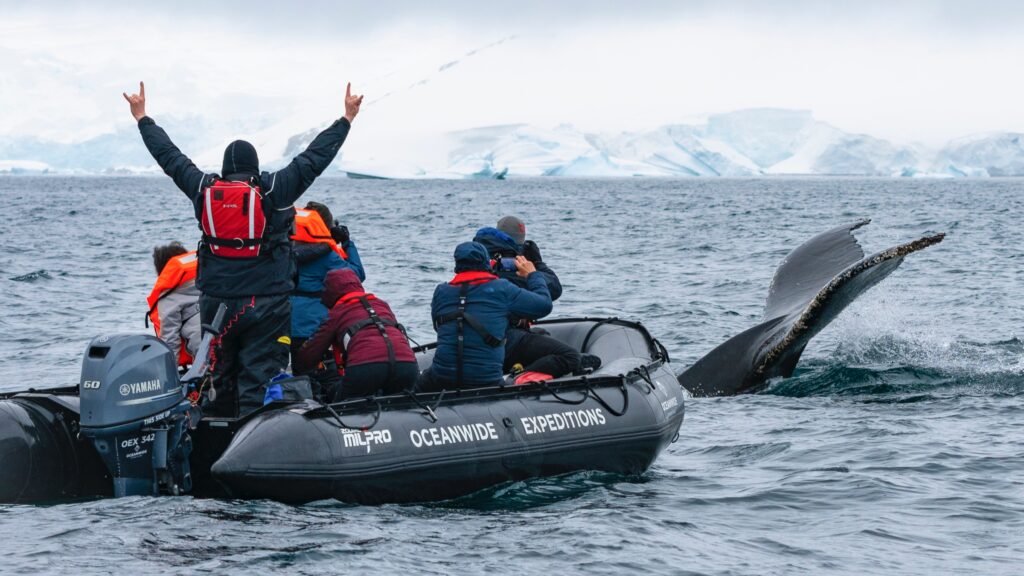
And that last part matters. If a seal is resting on the ice or a whale suddenly surfaces nearby, ten very excited people cannot all stand up and lean in the same direction at once.
If you’re taking photographs, your guide may ask one side of the boat to kneel or turn while the other side stays seated. That gives everyone a chance to see what’s happening without it turning into complete chaos. Just follow your guide’s directions, and don’t be afraid to ask if you need help or are hoping for a particular angle.
If boarding or mobility is a concern, bring it up before you book. Sitting in a Zodiac may be more manageable for some travelers than walking uphill or moving across an uneven landing site, but getting in and out is still part of the experience. Ask how transfers work on the specific ship and what assistance may be available for your needs.

Antarctica looks completely different from the water
Of course, penguins are endlessly entertaining on land. You can watch them fuss over their nests, feed their chicks, follow their well-worn paths through a colony, and chase one another around.
But watching them in the water is something else entirely, and it’s SO much fun! They dart, feed, and porpoise through the ocean, and suddenly you’re seeing a completely different side of these amazing birds.

That’s the thing about Antarctica: it’s a marine environment. Whales may surface or feed nearby. Seals rest on the ice. Glaciers and icebergs rise around you from a completely different perspective when you’re sitting close to the water.
A Zodiac gives you the chance to slow down and notice all of it. You may finally understand the size and shape of an iceberg you could only see from above on the ship. Or you may find yourself watching the same patch of water, hoping the whale that disappeared beneath it comes back up again.
Wildlife sightings are never guaranteed, but that unpredictability is part of what makes each Zodiac cruise so exciting.
Two boats can leave the same ship and come back with completely different stories. One group may have watched whales feeding while another found a leopard seal resting on the ice. Guides share sightings over the radio, but wildlife moves. By the time another boat arrives, the whole scene may have changed.
You’re not moving through a scheduled wildlife checklist. You’re exploring a living environment, and you get to see what happens while you’re out there. That’s what makes it so special.
You get dedicated time with someone who knows and loves this place
The guide on your Zodiac might be an ornithologist, glaciologist, historian, marine ecologist, or whale expert.
During a landing, you might ask a quick question before moving on to the next viewpoint. But in a Zodiac, you have time to keep talking and asking questions. Neill likes to think of it as a private classroom, except the thing you’re learning about is right in front of you.
If your guide is a glaciologist, you can look at the ice while learning how it formed. With a bird specialist, the penguin that just surfaced beside the boat may lead to a completely different conversation. Another outing might pair you with someone who understands whales or polar history. Every guide helps you notice something different, and suddenly you aren’t just looking at a beautiful landscape. You understand more of what you’re seeing.
You don’t need to arrive knowing exactly what you want to ask. Don’t worry, curiosity is enough! Your guide will often point out the first interesting detail, and the questions naturally follow from there.
You’ll also make your own memories with your guide and the other travelers in your Zodiac. Every outing is different, so there’s always something new to notice, learn, or talk about when you get back to the ship.

Bring the camera you can actually use
There’s a photo of Neill sitting in a Zodiac with thousands of dollars of camera equipment hanging beside him. Orcas are porpoising in front of the boat, and he’s recording them on his phone.
He had been photographing kayakers with long lenses when the orcas suddenly appeared. His phone was what he could reach quickly, so that’s what he used.
If you’re bringing a larger camera, think about how easily you can use it while sharing a small boat with other people. Wildlife does not wait while you dig through a bag or change lenses. A lens that can move between wider scenery and closer wildlife may be much easier than constantly switching equipment. Keep your camera protected from spray, and keep the equipment you want to use somewhere you can reach it without spreading everything around the boat.

And yes, your phone absolutely counts! Sometimes the best camera really is the one you can grab before the orcas disappear.
Plan as though you and your gear might get wet
Because you’re sitting still, you’ll probably feel colder than you did on shore. And yes, you may get splashed! Wind and spray are simply part of being out on the water.
Follow the clothing guidance for your exact voyage, and bring the recommended layers, hat, gloves, and waterproof protection. An extra pair of gloves in your backpack can be a very good idea when the pair you’re wearing gets damp. Our polar packing guide can help you think through the rest of your layers and gear.
A good dry bag also matters. Use it to protect your camera, phone, and anything else you definitely don’t want getting wet. Even if the day begins calm and sunny, polar conditions can change, and it’s much easier to enjoy the experience when you aren’t worried about your valuables. We also have a more detailed guide to protecting your phone and camera in Antarctica if you’re planning to bring valuable equipment.
Ask how Zodiac cruising fits into the expedition day
If you’re comparing ships mainly by passenger capacity or expected landing time, ask how the whole expedition program works. It also helps to understand what a typical day on an Antarctica expedition cruise may look like before you start comparing individual itineraries.
Some ships rotate groups between a landing and a Zodiac cruise. Other programs organize their outings differently. Weather, ice, staffing, and the location itself may also change what happens on a particular day.
A smaller passenger number does not automatically tell you how much dedicated Zodiac cruising you’ll have. Before choosing a trip, ask:
- Does the expedition regularly include dedicated Zodiac cruises, or are the boats mainly used for transfers?
- How are guests rotated between landings and cruises?
- What might the team do when conditions prevent a landing?
- How does boarding work on this particular ship?
- What should someone with mobility concerns discuss before booking?
You don’t need to know the logistics of how it will all come together. You just need to have an idea of whether the trip is going to give you meaningful time on the water, not just transport you between the ship and shore.
And if you’ve heard that you must book a ship with fewer than 100 passengers, it’s worth understanding what the 100-passenger rule actually means before you let that one number decide your trip.
The moment Neill knew he belonged in a Zodiac
During Neill’s first season as a guide, he was waiting just offshore at Danco Island while his passengers focused on the landing ahead of them.
Then a minke whale swam directly underneath his boat.
It startled him so badly that he shouted. The passengers jumped, and the expedition leader looked over from shore and told him to be more professional. Whoops! Neill’s defense was basically that a whale had just appeared underneath him and, for one very surprising second, he thought the boat might be knocked over.
That completely unplanned encounter was also the moment Neill knew he was born to be a Zodiac driver.
And that’s why his story matters when you’re planning your own trip. You may head out expecting to look at icebergs or search for wildlife, but the moment you remember most could be the one nobody saw coming. Zodiac cruising gives those unscripted moments room to happen.
Stepping onto Antarctica may still be the moment you’re most excited about, which is definitely something to look forward to. Be sure to leave some room for memories in the little inflatable boat, though.
Hear Neill, Nikki, and Phil talk more about Zodiac cruising and ship size in the full episode of The Drake Shake. They share plenty more stories in the complete conversation!